HAWORTHIA AND SUCCULENT AUCTION


This blog is dedicated to plants from desert regions around the world as well as plants that have adapted to withstand arid conditions, but do not occur in real deserts. Many of the plants are found in arid semi-desert regions. There will be a greater emphasis on succulent plants, but others will also be included. This blog deals with desert plants of the Americas, Africa, Arabia and others. We are situated in South Africa and South African plants are likely to feature more dominantly. The pictures taken are from our private botanical desert garden at Leopoort near Oudtshoorn, from plants in nature, as well as other collections.


Also visit out sister blog Desert Plants Images


Showing posts with label Conophytum. Show all posts

Conophytum truncatum ssp. truncatum var. truncatum is endemic to the Little Karoo.

This tiny succulent grows on hillsides in arid territory. Similar to others in the genus (e.g. Conophytum wettsteinii ) the plants grow in winter and are dormant and covered with a white sheath during the hot summer months.

The plant bodies are marked with dots or sometimes purple red lines.

The flowers appear in autumn and are yellow, white or pinkish.

Propagation is by seed or dividing the plant bodies.

Conophytum truncatum ssp. truncatum var. truncatum
Conophytum truncatum var. truncatum in habitat south of Oudtshoorn.
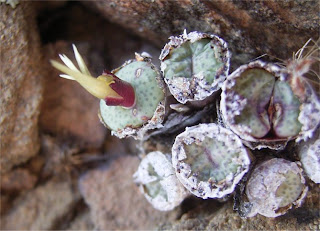
  1. Conophytum truncatum ssp. truncatum var. truncatum
  2. Flower.

Conophytum truncatum ssp. truncatum var. truncatum
Seed capsule.


Conophytum burgeri has a very localized distribution around the mines near Aggenys.

This strange looking desert plant is often aptly referred to as "Burger's Onion".

Unlike many conophytums (e.g. Conophytum wettsteinii and Conophytum stephanii ) it is a spring and summer growing plant. During winter the plants are covered by a white sheath. The plants usually consist of a single body and will rarely make 2 or 3 bodies. Propagation therefore is only by seed.

The plants are very slow growing, but otherwise not difficult to cultivate. Sowing in early summer gives best results.

Old plants can reach the size of a chicken egg.

The flowering time in South Africa is April-May.


Conophytum burgeri flowering in early May.


Conophytum burgeri flower.


The distribution of Conophytum wettsteinii subsp. wettsteinii is mainly in the Richtersveld mountain desert from Steinkopf in the south to approximately Kouefontein in the north.

Cultivation is very easy and the plants seem to be resistant to over watering.

The flowers are magenta to pink and occur in autumn.


Conophytum wettsteinii subsp. wettsteinii in cultivation.


Conophytum wettsteinii subsp. wettsteinii flower.


The distribution of Conophytum ernstii subsp. cerebellum seems marginalized to a small area east of Sandberg in Namibia.

The flowering time is in autumn and the flowers are rosy-pink on the outside, changing to whitish in the middle.

Conophytum ernstii subsp. cerebellum is easy to cultivate. Like all Conophytums the plants are dormant in summer and get protected with a white or brown sheath (skin) over the plant bodies during this time. Watering should be minimal during the summer months.


Conophytum ernstii subsp. cerebellum. Plant bodies start to break through the protective skin after the dormant period.


Conophytum ernstii subsp. cerebellum flower.


Conophytum stephanii var. stephanii occurs in the Richtersveld desert of the Northern Cape. Steven Hammer reports that the plants are found in the vicinity of Eenriet and Kabinaberg, and extent from there to Umdaus and Rosyntjieberg.

Conophytum stephanii var. stephanii has small reddish-brown flowers that appear in early autumn.

Conophytum stephanii var. stephaniiConophytum stephanii var. stephanii in cultivation.